Driving on a Dual Carriageway:
A Beginner's Guide
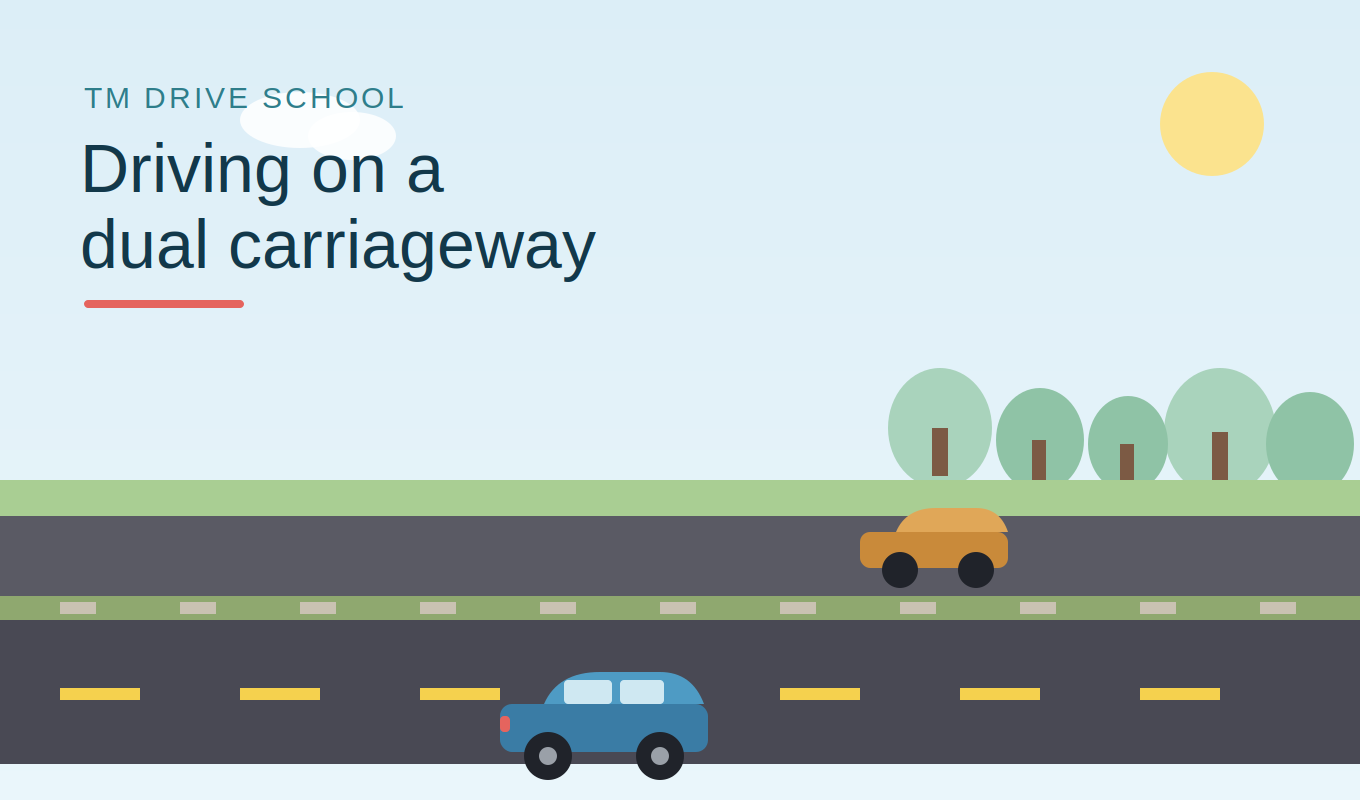
Quick answer: A dual carriageway is a road with a central reservation, such as a barrier or strip of land, splitting the two directions of traffic. It can have one or more lanes each way. The national speed limit for cars on a dual carriageway is 70mph, unless signs say lower. You give way when joining, keep left, and overtake on the right.
Dual carriageways feel fast and busy, which puts a lot of learners on edge. The skills are simple once you break them down: join safely, hold your lane, keep your speed steady, and overtake with care. This guide covers what a dual carriageway is, the speed limits, and how to drive one with confidence.
Key facts at a glance
What is a dual carriageway?
A dual carriageway is any road where a central reservation separates traffic going in opposite directions. That central reservation can be a metal barrier, a kerb, or a strip of grass. The number of lanes does not define it. A road with one lane each way is still a dual carriageway if it has that central divide, and a road with two lanes each way but no divide is a single carriageway.
What is the speed limit on a dual carriageway?
The national speed limit for a car or motorcycle on a dual carriageway is 70mph. For a car towing a trailer or caravan it is 60mph. These apply only where no lower limit is signed, so always check the signs, because many dual carriageways in and around towns are set to 50mph or 40mph. If street lights are present and there are no speed limit signs, the limit is usually 30mph.
Dual carriageway vs single carriageway
The difference is the central reservation, not the number of lanes. A single carriageway has no physical divide between the two directions, and its national speed limit for cars is 60mph. A dual carriageway has that divide, and its national limit for cars is 70mph. Knowing which one you are on tells you the default speed limit when there are no signs.
How to join a dual carriageway
Joining safely is the first skill. Where there is a slip road, build your speed to match the traffic already on the road, check your mirrors and blind spot, signal, and merge into a safe gap without forcing others to brake. Where the dual carriageway starts from a junction or roundabout instead, you give way as normal, then build speed once you are on. The aim is the same: join at the speed of the traffic, not well below it.
Driving on a dual carriageway
Once you are on, keep to the left lane unless you are overtaking. The other lanes are for overtaking, not for cruising. Hold a steady speed, keep a safe gap to the car in front, and check your mirrors often, because traffic moves faster here and gaps close quickly. Use the two second rule for your following distance, and double it in the wet.
Overtaking and leaving
Overtake on the right, never the left. Check your mirrors and blind spot, signal, move out when it is clear, pass, then move back to the left once you can see the car you passed in your mirror. To leave, watch for the exit signs, move into the correct lane in good time, signal, and slow down on the slip road, not on the carriageway itself.
Can learners drive on a dual carriageway?
Yes. Learners can drive on dual carriageways, and it is a normal part of lessons, with L plates on and a supervisor beside you. This is different from motorways, where you can only drive as a learner with an approved instructor in a dual control car. Practising dual carriageways before your test builds the speed judgement and lane discipline the examiner wants to see.
Frequently Asked Questions
Build confidence on faster roads
Dual carriageways feel far easier once you have driven them with an instructor guiding every join and overtake. TM Drive School builds this into manual lessons across West London, so test day holds no surprises. See our prices and book a lesson, learn how to pass your test first time, or see what to expect on your driving test day.