How Many Hours of Driving
Lessons Do I Need? (UK Guide)
You want a number. A clear one. Something to write on a budget plan and a calendar.
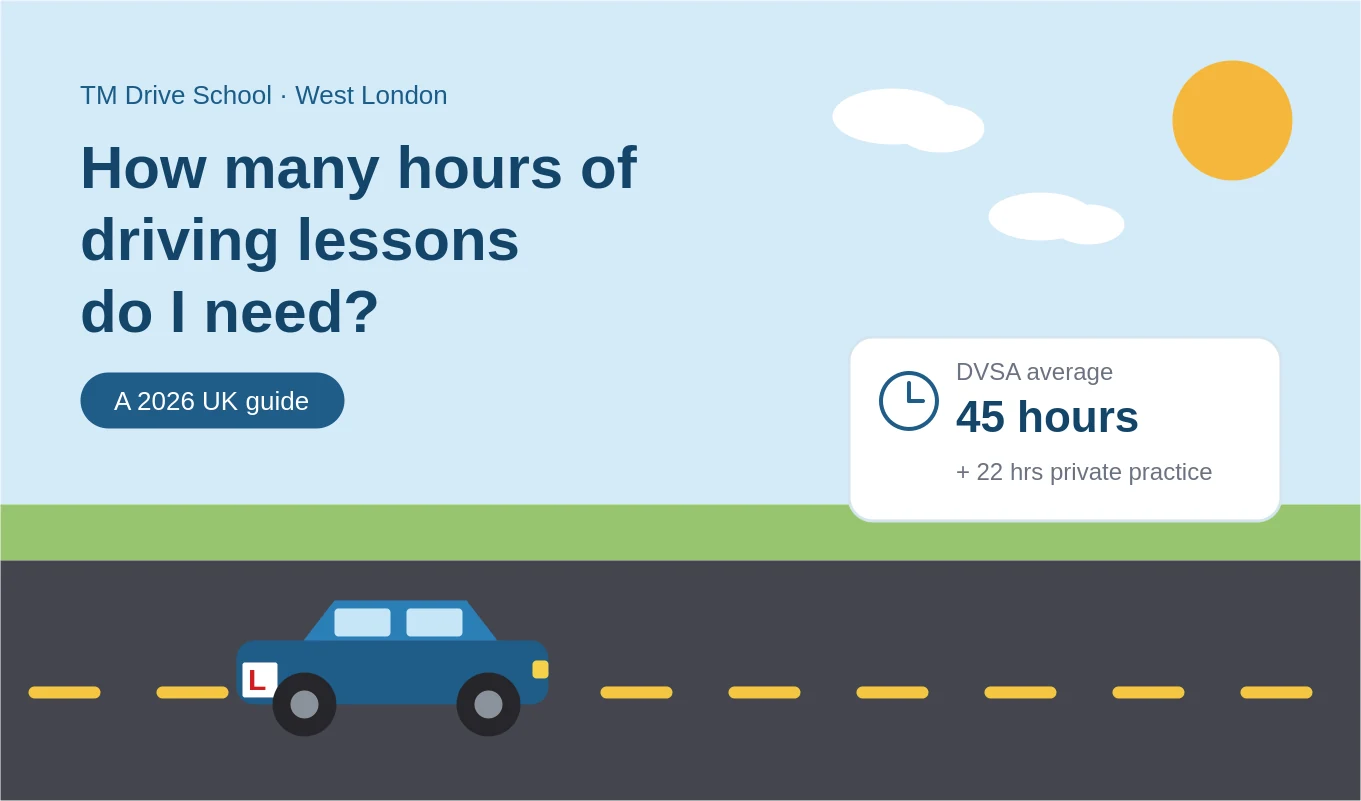
Here is the honest answer up front: most UK learners pass after about 45 hours of lessons with an instructor, plus around 22 hours of private practice. So roughly 67 hours of driving in total before you sit the test. Learn in a busy spot like West London and your own total may sit a little higher, simply because the roads ask more of you.
But the number on its own can mislead you. Some people pass in 20 hours. Others need 60 or more, and both groups end up with the same full licence. This guide breaks down where the 45-hour figure comes from, what changes your own total, and how to plan your hours so you do not waste money.
The Short Answer
The Driver and Vehicle Standards Agency (DVSA) runs the Ready to Pass campaign, and their research gives the benchmark most schools quote:
There is no legal minimum. You can book your practical test the moment you pass your theory test, with zero required training hours first. What the examiner cares about is one thing: can you drive safely and on your own for about 40 minutes? The hours simply help you reach that point.
One more figure worth knowing: learners who mix paid lessons with private practice are around 50% more likely to pass first time, according to DVSA data. Practice is not optional padding. It does real work.
Why the 45-Hour Figure Is an Average, Not a Target
The 45 hours describes the typical learner who passes on a first attempt. An average hides a wide spread, so do not panic if you sail past it. Your own total depends on a handful of honest factors:
Your age and reaction speed
Younger learners often pick up the controls quickly but need more road-reading practice. Older learners tend to be more cautious and focused.
Past Experience
Driven a quad bike, a tractor, or a car abroad? You may need fewer hours.
Where You Learn
Quiet rural roads are gentler than a busy city centre full of mini-roundabouts and bus lanes. London learners usually need more time than someone in a small market town. Tight, busy areas such as Notting Hill, Fulham, South Kensington, and Maida Vale build strong skills, but they take a few extra hours to master.
Lesson frequency
Two lessons a week builds muscle memory. One lesson a fortnight means you spend half of each session remembering the last one.
Nerves
Anxiety is normal and very common. Nervous learners often need a few extra hours to feel calm, and the time is well spent.
Manual or Automatic
Clutch control and gear changes add a layer to learn.
None of these make you a “slow” learner. Taking longer often means you become a safer, calmer driver, which matters far more once you are out there alone.
What You Learn, Hour by Hour
Here is a rough map of how the hours tend to fill up. Treat the blocks as a guide, not a rulebook, since everyone moves at their own pace.
Hours 1–10: The Basics
Focus on the cockpit drill (mirrors, seat, steering, seatbelt), main controls, and moving off/stopping without stalling. You will master clutch control, basic steering, and short drives on quiet streets. By hour 10, most people handle a simple T-junction with a few prompts.
Hours 11–30: Building Road Skills
This is the busiest block, covering common test fault areas: roundabouts (mini, small, and large), bay parking, parallel parking, reversing, and the mirror-signal-manoeuvre routine. Expect to navigate faster roads and trickier junctions.
Hours 31–45: Polishing for the Test
Sharpening your skills. You will drive busy routes with minimal intervention, practice independent driving, learn to fix small mistakes calmly, and run mock tests. The goal is steady, safe driving with no prompts at all.
Manual vs Automatic: Does One Need Fewer Hours?
Many learners ask which gearbox saves time and money. Here is a fair comparison.
| Factor | Manual | Automatic |
|---|---|---|
| Typical hours to test-ready | 40–50 hours | Often a few hours fewer |
| What you learn | Clutch, gears, hill starts | No clutch or gear changes |
| Licence you get | Drive manual and automatic | Automatic cars only |
| Lesson cost per hour | Lower | Usually 10–15% higher |
| Best for | Most learners, future flexibility | Nervous learners, or anyone set on automatic or electric cars |
Best for fewer hours: Automatic, because you drop the clutch and gear learning curve.
Best for long-term value: Manual, because the licence covers both types of car. Pass in an automatic and you must take another test later if you want to drive a manual.
A quick note on what we offer:TM Drive School teaches manual lessons only, in a modern Mercedes A-Class. A manual pass keeps every door open, so you can drive any car once you hold your full licence.
How Lesson Frequency Changes Your Timeline
The same 45 hours feels very different depending on how you spread them out.
| Plan | Lessons per week | Time to test-ready (45 hours) |
|---|---|---|
| Slow and steady | 1 hour | Around 45 weeks (nearly a year) |
| Recommended pace | Two 1-hour lessons | About 5–6 months |
| Licence you get | Faster pace | Two 2-hour lessons |
| Around 3 months | Lower | Intensive course |
| Best for | Daily, block-booked | Under 2 weeks |
Most instructors suggest two-hour lessons once you have the basics. You get enough time to drive somewhere varied and master one tricky skill, without wasting the first ten minutes warming up. If a shorter, faster plan suits you better, ask us about an intensive driving course
The Real Cost of Your Hours
Hours cost money, so it helps to plan the spend. In 2026, the most common rate sits at £36–£40 per hour, though the full range runs from about £30 to £50 depending on where you live.
London and the South East:
£40–£50 per hour.
Wales, Scotland and Northern England:
£30–£40 per hour.
Automatic lessons:
roughly 10–15% more than manual
At an average of £38 an hour, 45 hours of lessons works out at around £1,710. Add the provisional licence (£34 online), the theory test, the practical test fee, and fuel for private practice, and most first-time passers spend £1,800–£2,800 in total. A quick money-saving point: the national first-time pass rate sits at roughly 48%, so budgeting for one retake is sensible rather than gloomy. To see current rates for your area, check our lesson prices. Block-booking lessons often shaves a few pounds off each hour too.
How to Know You Are Actually Ready
Forget the hour count for a moment. You are ready when you can do these things calmly and without help:
When your instructor sees these for several lessons in a row, you are at test standard. The number of hours behind you matters far less than steady performance.
Smart Ways to Need Fewer Hours
Practise privately
Every supervised hour in a friend's car reduces paid lesson time. Just make sure the supervisor is over 21 and has held a full licence for three years, and that the car is properly insured.
Keep lessons regular
Two a week beats one big session a month for retention.
Pass your theory early
Sit it before you start spending heavily on practical lessons, so you are ready to book the test the moment your instructor gives the nod.
Track your weak spots
Keep a note of the manoeuvres you have nailed and the ones you have not, so each lesson targets a gap.
Choose a local instructor
Less driving to a quiet practice area means more useful driving time.
Want proof a steady, calm approach works? Read how our pupils pass first time, often with very few faults.
Frequently Asked Questions
The Bottom Line
Aim for around 45 hours of lessons and 22 hours of private practice, but treat the figure as a signpost, not a finish line. Book regular lessons, practise between them, and judge your progress by how safely you drive rather than how many hours sit in your logbook. Pass when you are genuinely ready, and the licence will serve you well for decades.
Learning to drive in West London and want a calm, patient instructor?View our lesson pricesorget in touchto book your first manual lesson.