How to Parallel Park:
A Simple Step by Step Guide
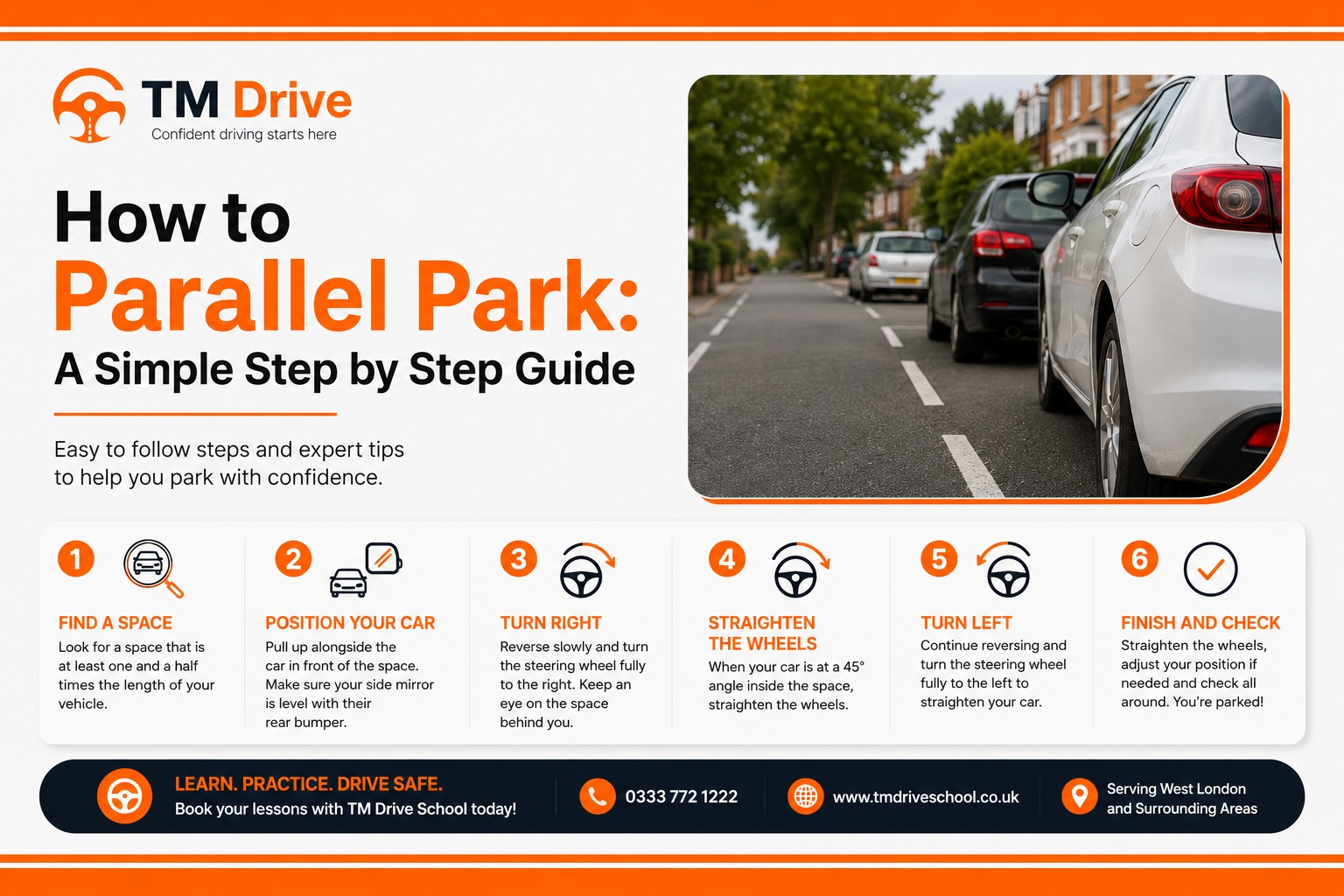
Quick answer: To parallel park, pull up level with the car in front of the space, about a metre out. Reverse and turn one full turn left as the back of your car swings in. When the kerb shows in your left mirror, straighten the wheels, then turn right to bring the front in. Stop close to the kerb and straight.
Parallel parking is the manoeuvre most learners fear the most. The good news is simple: it runs on a fixed set of steps and reference points, not luck. Learn the order once and you can repeat it on any road. This guide gives you the steps, the reference points, and the parts the driving test examiner marks.
When will you be asked to parallel park?
The examiner picks one manoeuvre from a small set on the day, and parallel parking is one of them, so there is a real chance you will get it. You reverse into a space behind a parked car and finish close to the kerb, within about two car lengths of the car in front. You also need the skill for daily driving, since a reverse into a gap fits a smaller space than driving in forwards.
How much space do you need?
Aim for a gap around one and a half car lengths or more while you are learning. A longer gap gives you room to move without stress. As you get better, you can park in tighter spaces. On the test, the examiner chooses a space with enough room, so you will not be set up to fail.
The 1-2-1 method, step by step
Most UK instructors teach the 1-2-1 method (also written 121). The name is the steering pattern: one turn, then two turns, then one turn. Here is the full manoeuvre.
Keep checking your mirrors and blind spots the whole time, and stop for any car, cyclist, or person who comes near.
The reference points that make it work
Reference points are the fixed markers that tell you when to turn. They vary a little by car, so set yours with an instructor, then they stay the same every time.
| Stage | What to look for |
|---|---|
| Start position | Your back wheels level with the other car's back wheels |
| First turn (left) | Begin as the back of your car draws level with the parked car's rear |
| Second turn (right) | When the kerb appears in your left door mirror, or the far kerb lines up in your rear window |
| Straighten | When your car sits parallel and centred in the space |
Once you know where the kerb sits in your mirror for your car, the guesswork goes.
Clutch control: the manual driver's edge
In a manual car, slow speed is everything, and slow speed comes from the clutch. Hold the clutch at the biting point and let the car crawl, so you have time to steer and check. If you need to pause, dip the clutch. This slow, controlled crawl is what our manual driving lessons in West London drill until it feels natural, and it is the single biggest reason learners lose or keep control on this manoeuvre.
Parallel parking on tight, busy streets
Real roads are harder than a quiet practice street, and West London is a good example. Around South Kensington and Chelsea, cars park on both sides, the gaps are short, and traffic waits behind you. Three things help. Take your time, since other drivers should wait while you park. Do your checks even with a car behind, because the manoeuvre still needs full observation. And if the space is too tight, drive on and find another, rather than forcing it. Practising on these streets before your test means nothing on the day feels new.
Common mistakes to avoid
Is failing the parallel park an automatic fail?
No. Lightly touching the kerb, or making a small correction, is usually a minor fault. You only fail if you lose control, hit or get too close to another car, mount the kerb badly, or ignore other road users. Those count as a serious or dangerous fault. So a calm correction is safe, but rushing and missing a check is what costs the test.
Frequently Asked Questions
Ready to nail the parallel park?
Steps get you started, but real skill comes from practice with feedback. Book a manual lesson with TM Drive School and we will drill the parallel park on the same West London streets you will be tested on. See our prices and book a lesson, or read what to expect on your driving test day next.